
Rosa shows up for her yearly visit convinced she can skip a step: "My ultrasound last year was fine, so I don't need a Pap this time." Across the waiting room, someone else has the opposite idea: "My Pap came back normal, so my ovaries must be okay." Both are mixing up the same two things. These tests look at the same part of the body, sometimes during the same appointment, yet they answer completely different questions.
Knowing what each piece of a gynecology check-up actually looks at makes it easier to follow why the clinic's medical team suggests one test, the other or both, and to leave knowing exactly what was checked and what was not.
Three pieces, three separate questions
A full gynecology check-up is not a single exam. In the gynecology visit at Clínica Hispana La Caridad, depending on your situation, it brings together your history, a pelvic exam, a Pap smear with or without HPV testing and, whenever the uterus or ovaries need to be seen, a pelvic ultrasound.
| Part of the check-up | What it looks at | What it cannot tell you | How it is done |
|---|---|---|---|
| Pelvic exam | How the vulva, vagina and cervix look; areas that feel tender | Exact organ size or what is happening inside the tissue | A speculum exam plus gentle pressing by hand |
| Pap smear | Cells from the cervix, looking for changes before they cause symptoms | Anything about the inside of the uterus or the ovaries | A small brush sample that is sent to the lab |
| HPV test | Whether virus types linked to those cell changes are present | Nothing about organ shape or size | Run on the same sample, or one collected alongside it |
| Pelvic ultrasound | Size, shape and outline of the uterus and ovaries; the bladder as well | Whether cervical cells are changing | Gel on the lower belly and a handheld probe that builds the image |
The short version: the Pap smear works at the level of cells, and the ultrasound works at the level of organs. One reads cells under a microscope; the other measures structures on a screen.
Why neither one can stand in for the other
The changes a Pap smear is designed to catch happen in a layer of cells far too thin for any image to show. A cervix can look completely ordinary on ultrasound and still carry cells worth keeping an eye on. A clear ultrasound, then, does not push back or cancel the Pap smear you are due for.
It works the other way too. The Pap sample comes from the cervix, the narrow opening of the uterus, and says nothing about what lies beyond it. If your periods have been getting heavier, or you feel pressure low in your belly, a normal Pap smear does not explain any of that. What helps there is a look at the uterus and ovaries.
As for timing, the clinic's gynecology page follows the U.S. Preventive Services Task Force (USPSTF): cervical cytology every 3 years from 21 to 29, and from 30 to 65 the interval can stretch to 5 years when paired with HPV testing. An earlier abnormal result shortens that interval. Pelvic ultrasound has no set calendar like this; it is ordered based on what the visit calls for.
When the ultrasound gets added to the same visit
Not every check-up includes an ultrasound, and leaving it out does not mean anything was skipped. The clinic's ultrasound page puts it plainly: the pelvic scan is done during the same gynecology visit when the visit calls for it. In real life, that tends to look like this:
- Something you mention at the start. Pain, bleeding that has drifted away from your usual pattern, or a discomfort that has lingered for months can lead the medical team to suggest looking at the uterus and ovaries right then, without sending you somewhere else.
- Something noticed during the pelvic exam. When the hands-on exam hints that a closer look is worthwhile, the ultrasound shows whether size or shape has changed.
- A question to settle. The page itself lists suspected fibroids and cysts among the usual reasons for a pelvic scan.
- Following up on an older finding. If a past ultrasound showed something, repeating it shows whether it has changed.
If your period is late, the usual first step is a pregnancy test before choosing the next study, because pregnancy changes which kind of ultrasound makes sense.
How the visit runs when you have both
When the check-up includes both tests, the order is usually simple: the conversation first, then the pelvic exam with the Pap sample, and the pelvic ultrasound last. That scan needs a full bladder, which acts like a window for a clearer view of the uterus. If you already know it is on the plan, ask how to arrive ready when you call; if it comes up during the visit, the clinic team will walk you through what to do.
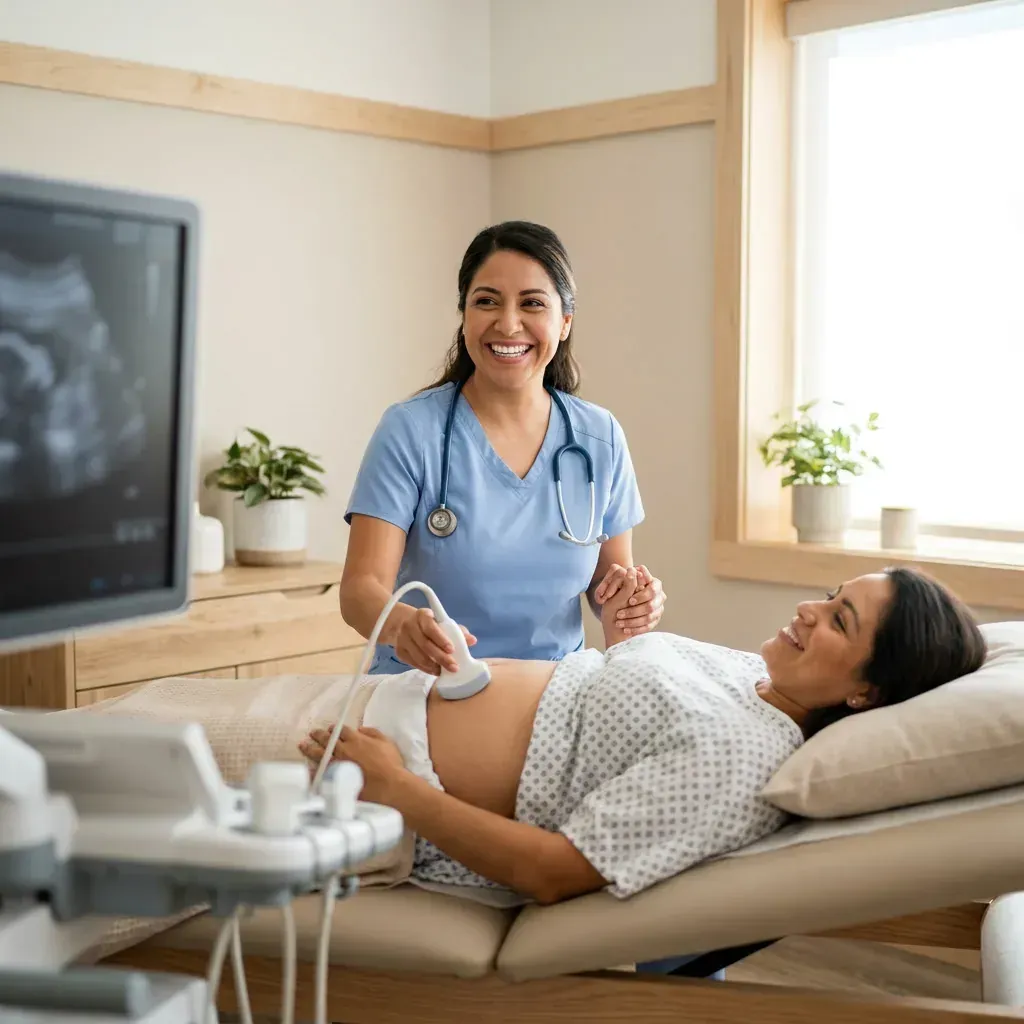
The ultrasound uses no radiation, does not hurt and is done from the outside, over the skin of your belly. It takes 15 to 30 minutes depending on what is being studied, and you can go straight back to your day afterward.
One practical point: a Pap sample is best taken when you are not on your period. If you come in while bleeding, the medical team will weigh doing the ultrasound now and collecting the sample at a later visit.
What to bring
These details make the appointment far more useful:
- The date your last period started.
- When your last Pap smear or HPV test was, plus the result sheet if you have it, especially if one ever came back abnormal.
- The report from any earlier pelvic ultrasound, even one done at another clinic or in another country. Old measurements are what a new scan gets compared against.
- A list of your medicines and the birth control you use, if any. If you are thinking about switching, you can bring it up at the same visit through the birth control service.
Questions worth asking
Asking is never a bother, and walking out with a clear picture is part of the check-up:
- "Does my sample include an HPV test, or cytology only?"
- "Why do I need an ultrasound today?" Or, if none was suggested, "Why isn't one needed this time?"
- "How do the size and shape of my uterus and ovaries compare with my last scan?"
- "How will I hear about my Pap result once it is back?"
- "If I need a different study, will I get a report to take with me?"
On that last one the clinic is direct: when another technique is needed, the medical team tells you and hands you the report. For the Pap smear, you are contacted as soon as results arrive and they are explained to you in Spanish or English, along with the plan.
What should not wait for a check-up
A check-up is for looking after yourself without hurry. Sudden, severe belly pain, very heavy bleeding, fever with pelvic pain, dizziness or fainting, or any bleeding while pregnant is a different matter: go to the emergency room or call 911 instead of booking a visit.
A check-up you fully understand
At Clínica Hispana La Caridad, serving the Sharpstown area (77036), the gynecology check-up and the pelvic ultrasound both happen under one roof, with everything explained in Spanish or English. The visit is walk-in; if you already know an ultrasound is part of it, call (832) 925-8135 before you leave home to ask how to come prepared. And if this year only your Pap smear is due, that is not half a check-up. It is the right test for what needs checking.
Need medical attention?
We're here to help. Call now to schedule your appointment or visit our clinic without an appointment.
Call now: +1 (832) 925-8135Related services
Ultrasound & Sonography
Ultrasound and sonography in Houston, TX: abdominal, pelvic and pregnancy. In Spanish, with affordable pricing.
Gynecology Care: Pap Smear & Cultures
Gynecology care in Houston, TX: Pap smear, vaginal cultures and infection treatment. In Spanish, with affordable pricing.
Pregnancy Testing & Confirmation
Pregnancy testing and confirmation in Houston, TX. Reliable tests and guidance in Spanish, with affordable pricing.
Contraceptive Methods
Contraceptive methods in Houston, TX: guidance, pills and injection. In Spanish, with affordable pricing.